Artist Statement #2
Redesigning a Board Game to Form a Critique
For Hack #2, I decided to use the board game, “Mouse Trap,” and redesign it to focus on the life of Immigrants residing in the United States. I used my own experience as having parents in this exact situation in order to influence my decisions for the design of the board game. I renamed my board game as, “House Gap” which could be misleading as someone may think am trying to discuss the issue of homelessness in America. However, I chose this name because Latinos tend to create a shelter, or “house,” out of their situations, but America is not their “home” per se. The goal of the game is to create a home, however that may be. For some Latinos, this means returning to their home country with the wealth and knowledge they were able to obtain in the US whereas for others, this means creating a space of belonging in the US because they have rooted themselves and their families in a new space and are finally comfortable. I also chose to use the word gap for the name because there is this deep sense of not belonging amongst Latinos living in the United States. They feel as though they are living in between two different worlds, too different for either one. Gap is defined as a “break in barrier” which relates to the physical break once Latinos cross the border between Mexico and the United States, but also with the idea of “a separation in space,” because of this unified feeling of not belonging and being within two different cultures while also trying to navigate other aspects of everyday life.
CONTEXT: How To Play the Original Mouse Trap
Recreating the Board Game Box
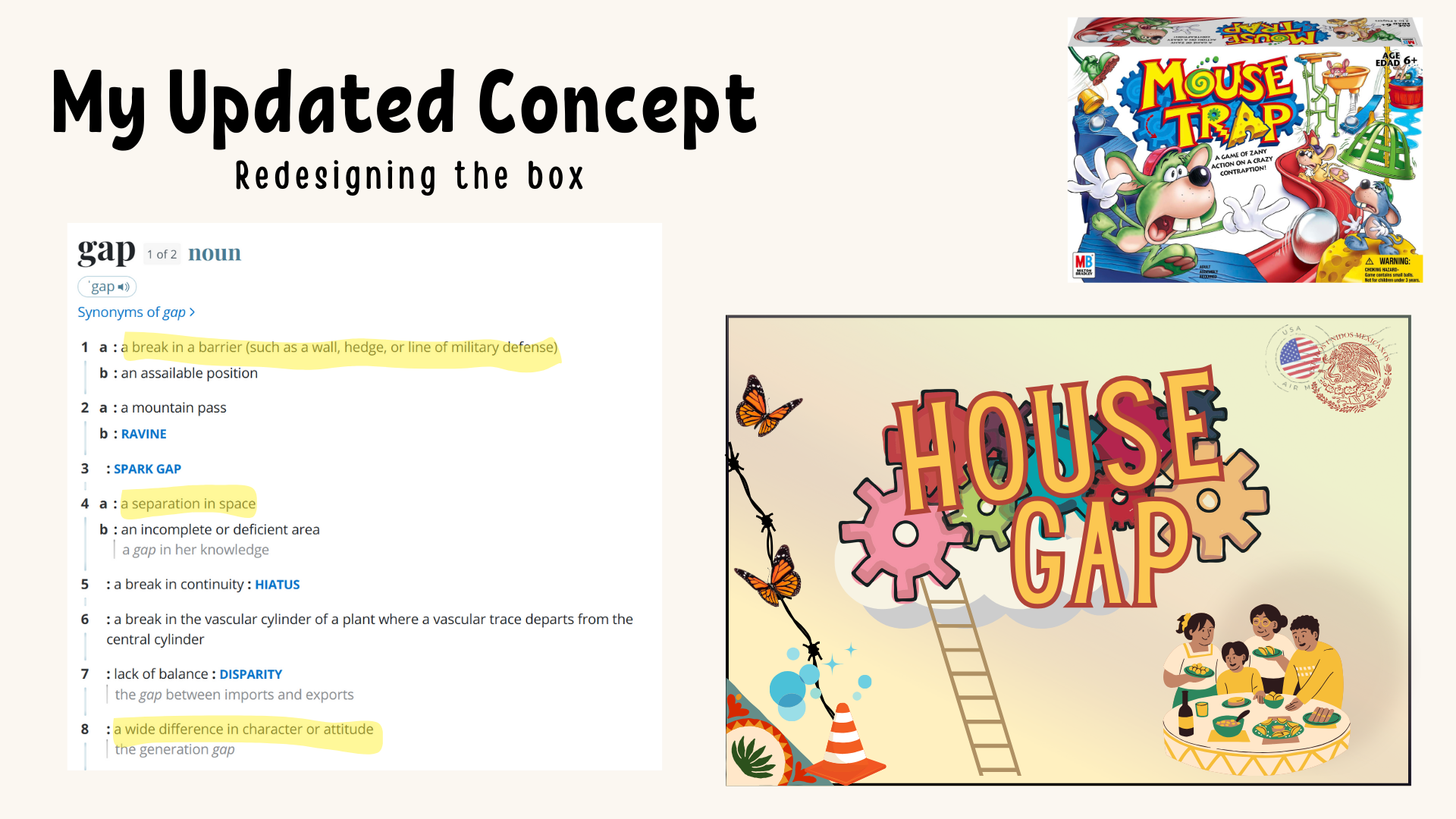
Although I don’t think we had to actually redesign the physical box that the board game comes in, I decided it would help create a more developed reskinned game. When I first started creating my box, I decided that the first step would be to rename my game as it now would have nothing to do with mice, and keeping the name would feel a bit insensitive to immigrants in the US. For my name, I decided to go with “House Gap,” because of the idea that when immigrants come to the US, they have not necessarily found a home for themselves, but instead are living in this survival mode where they are seeking the bare minimum of a shelter and a space to begin their journey. I also decided to use gap as the second word in my title for two reasons. For my first reason, I found that gap means, “a break in barrier,” which is essentially how immigrants make their way into the United States if they are undocumented, but also because gap means “a separation in space”. Many immigrants, Latin Americans specifically, feel as though they are stick in this space where they don’t belong to either community that they are in.
Recreating the Board Game Itself
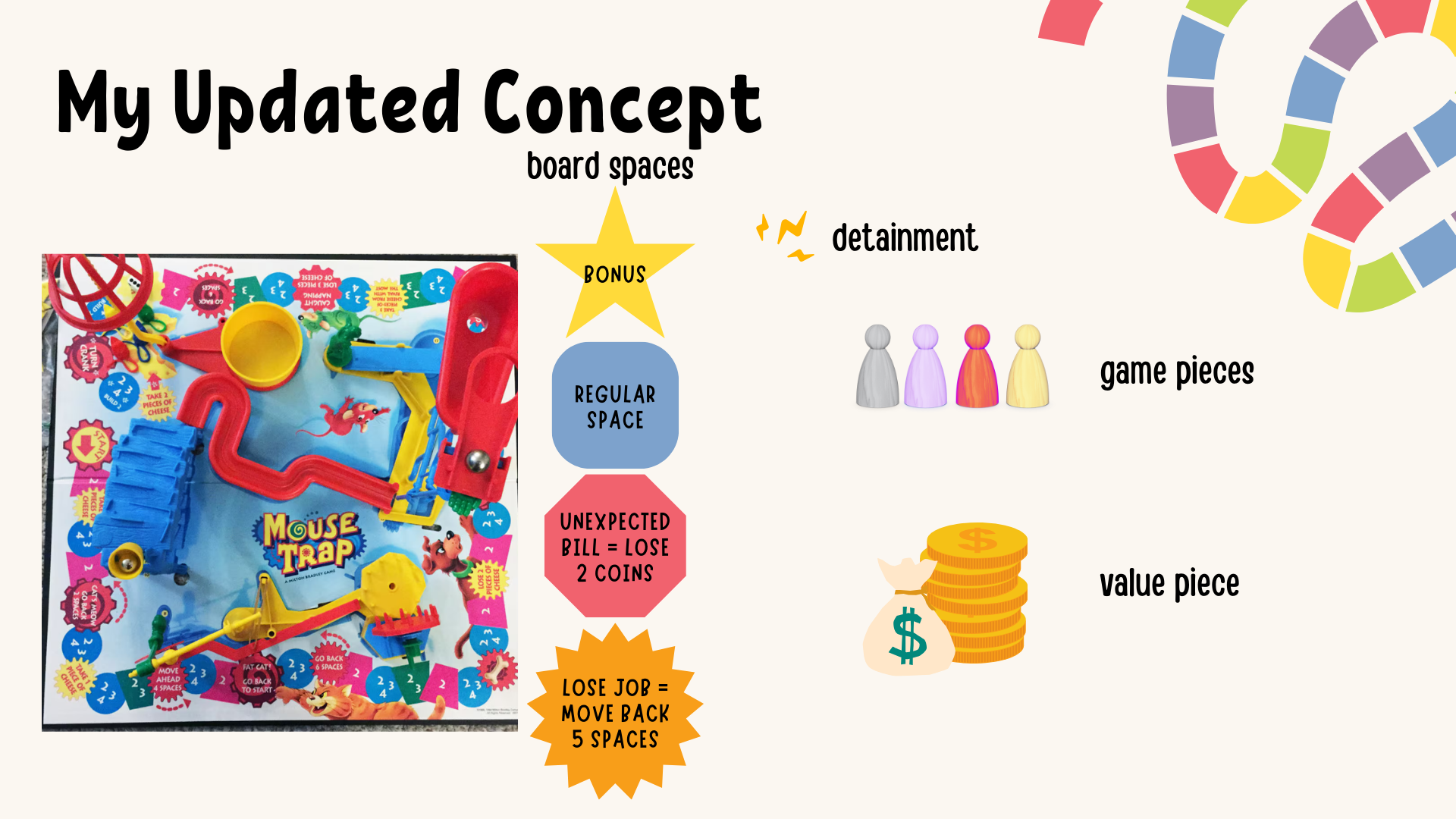
I designed the pieces of the game to correspond more closely with my idea of following an immigrant’s life in the US because the original pieces were too closely related to mice like the player pieces being mice or the value pieces being cheese in the original game.
The Actual Recreated Board Game
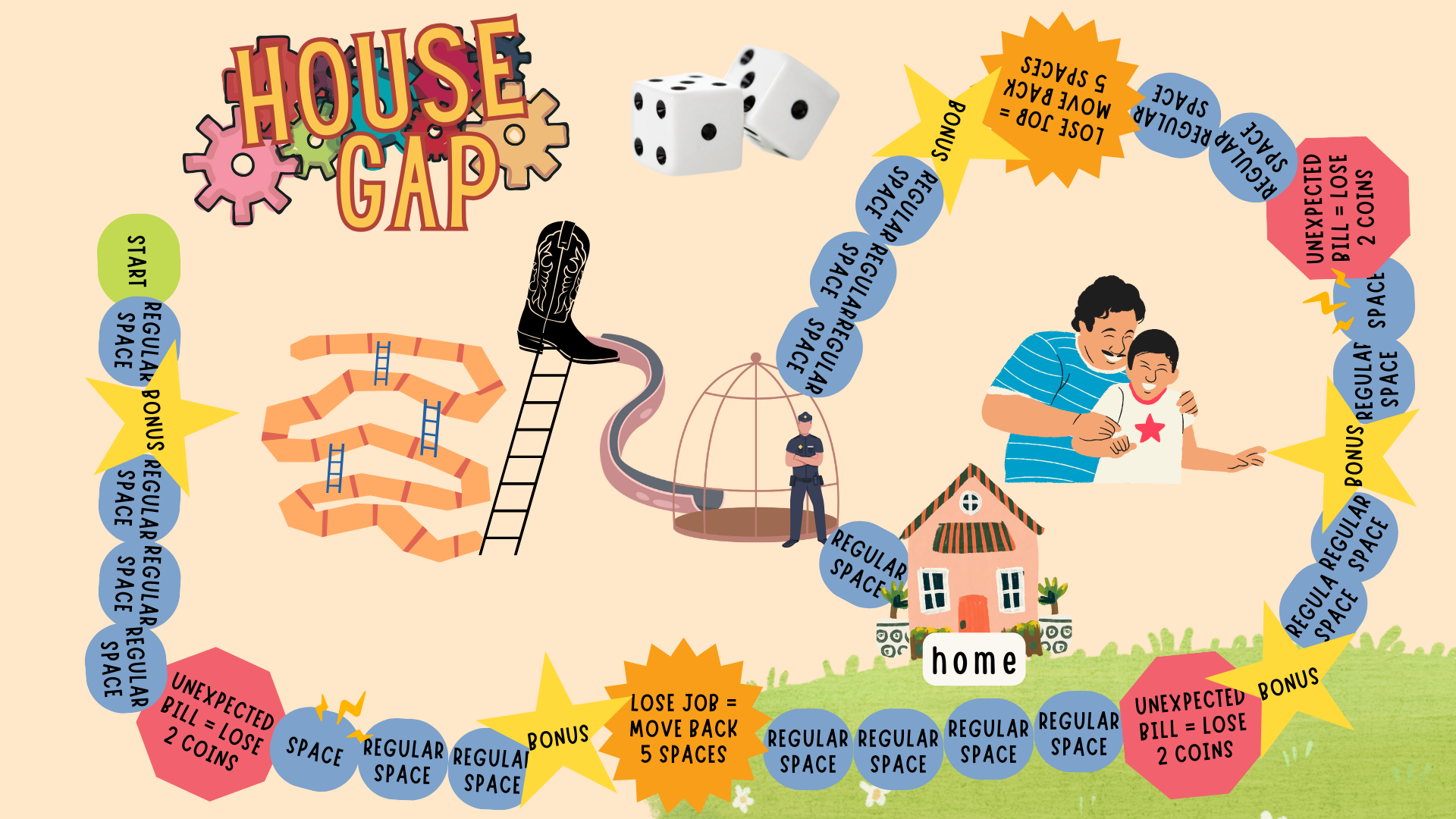
My recreation of the game board
Connection to Our Readings
“Most users rarely think about the material inside their computers, beyond their screens
or contained within the cartridge box. While this ignorance may seem natural, it is
engineered and embedded within the hardware’s design itself.” – Jaime Lee Kirtz
This idea of people not looking beyond what is right in front of them is something that I, and probably others realized while reskinning our games. These games seem like fun child-friendly games to play, but they can sometimes hold a darker meaning. For example, in Mouse Trap you are playing as a mouse build the trap and then trying to be the last mouse standing. This competition doesn’t seem as child friendly if you change the characters from mice to humans. This idea of the mice being worth less than humans seems to be an issue that could be analyzed in itself.
“Activist games can be characterized by their emphasis on social issues, education, and, occasionally, intervention. In other words, they are not purely conceptual exercises, but rather, games that engage in a social issue through, most commonly, themes, narratives, roles, settings, goals, and characters…” – Mary Flanagan
I think my project could be considered an activist game because it focused so much on issues that are prevalent to America today as we have the White House spreading so much hate and fear about undocumented immigrants whereas many are just trying to help support themselves and their families in a different country because their home does not provide them the capabilities to do so.
Trial & Error
For my second hack, I had originally decided that I would focus on the board game, “Operation,” as the structure for my reskin because I had been focusing on the idea of looking deeper in the illegal organ trafficking that is not talked about as much as other forms, such as sex trafficking, and yet is still an issue. The World Health Organization highlights that this form of trafficking has increased immensely in the past few years, and sometimes even goes hand-in-hand with sex trafficking. However, I decided against this topic and board game for my hack because I felt as though I wouldn’t be able to convey my ideas clearly enough or successfully in order to reskin “Operation” to the best of my ability.
An issue that I ran into when completing this hack was trying to redesign the actual board and box of the board game. My topic is serious, and the design of the board game is heavily marketed towards young children, so it is quite fun and whimsical. I wanted to create this redesign in a respectful manner, so trying to make decisions that keep the feel of the original game while also showcasing a serious topic caused me a bit of trouble.
Expansion
I believe my reskinned version of Mouse Trap could be modified further if I were to have had more time to do so. After receiving feedback on my presentation, I believe that I could do more expansive research into how to modify the mouse trap that is being created by players in the original game. I tried to do this idea of immigrants trying to create a home for themselves in America, but maybe there could also be the idea of immigrants helping build up America’s economy and infrastructure, but then at the end America turning their backs on them and forcing them into detainment because of their legal status. It’s an interesting idea, but it would take a bit more of processing in order to make a board where players are assembling something physical together.
Works Cited
- Mary Flanagan, Critical Play: Radical Game Design (2009)
- Jaime Lee Kirtz, “Beyond the Blackbox: Repurposing ROM Hacking for Feminist Hacking/Making Practices” from Ada: A Journal of Gender, New Media, and Technology (2018)
- Merriam Webster’s Dictionary, Gap
*updated recently to include information provided through feedback of presentation*

