Artist Statement #3
For my third project, I decided to use Spotify, a music streaming application, in a way that derives from the typical usage of it. For those who may not know what Spotify is used for, it is one of the largest mobile music streaming softwares in the world. It allows people all around the world to listen to all types of music, providing more artists than Apple Music, comparatively. For my project I decided to use Spotify as a journal of sorts, using folders, playlists, and songs to create a recipe book, with a playlist describing the necessary ingredients and another playlist describing the step by step process of making an apple pie. This project could definitely be expanded in a way to include other recipes that perhaps sound follows each step/ingredient in order to help people connect music to their cooking or baking journey ( a musical recipe of sorts).
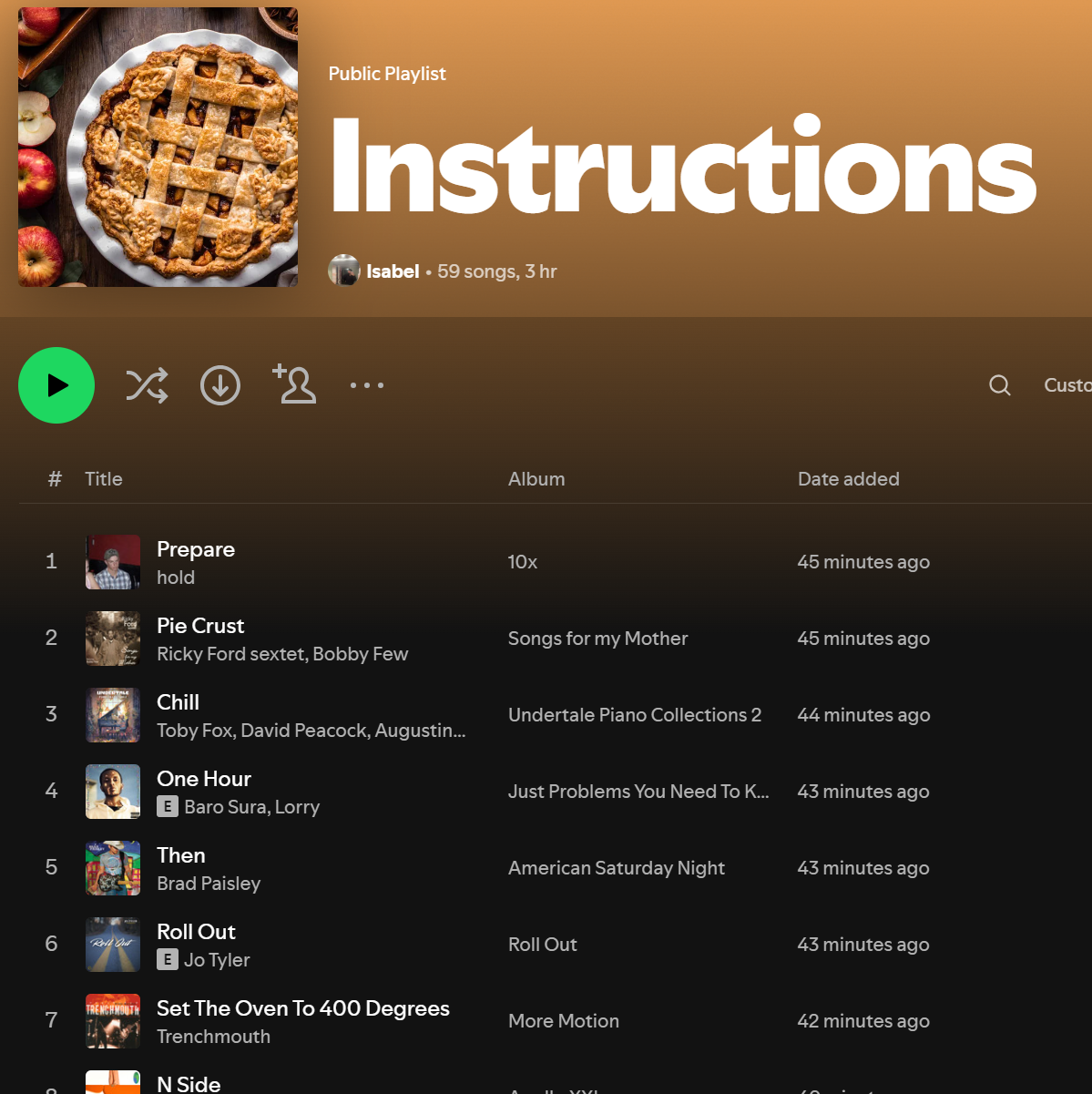
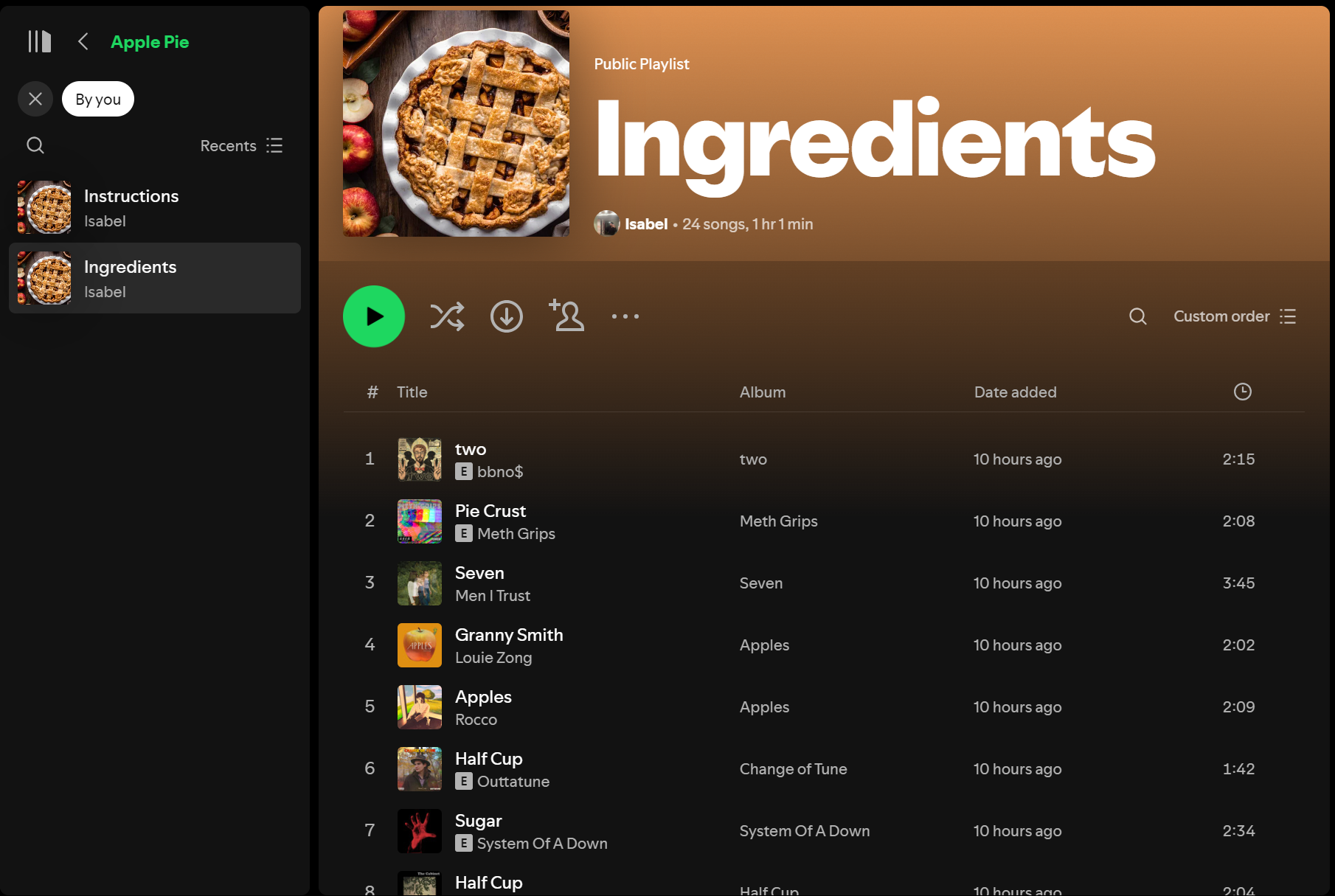
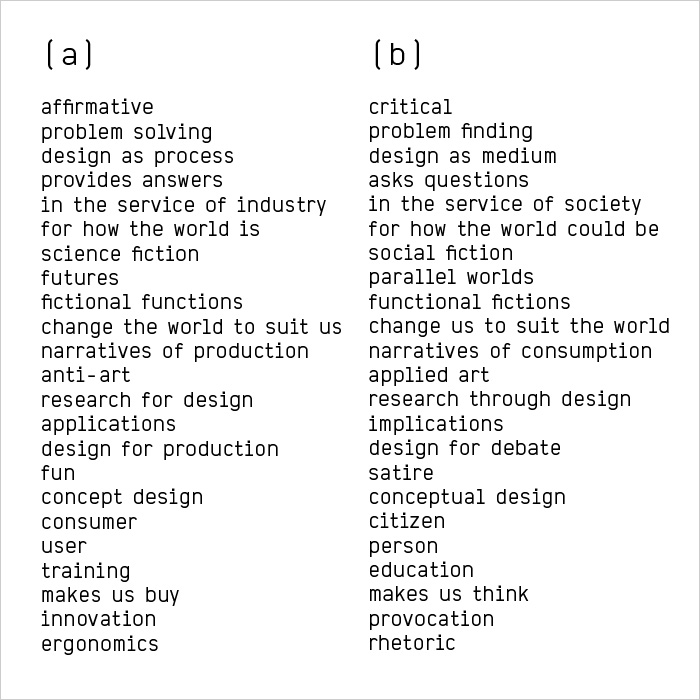
After viewing the A/B list in Speculative Everything, I decided that I wanted to pursue my hack in the aspect of fun (A) /humor (B) because there was not as much of a critique which was visible in my previous gap, the reskinning of Mouse Trap. I think I also looked at this list and found it a little difficult to connect to my project because it wasn’t as deep in meaning, but looking further into my reading it became increasingly easier to visualize how viewers should interact with my project. “The viewer should experience a dilemma: is it serious or not? Real or not?” (Dunne) When people view my playlists, I want them to think to themselves about whether the instructions and ingredients listed will actually provide them with a classic American dessert when its all said and done.
After initially having trouble beginning my design, I honed in on this aspect of the creation of critical design, “when technology is always assumed to be good and capable of solving any problem.” (Dunne) Having such a difficult time trying to think outside of the box and come up with a new idea for an app’s usage, I realized that thinking more critically about the apps that I used everyday would provide me with a clearer vision of what I could be capable of doing for this hack. Before I had my idea in using Spotify I had a completely blank mind because I have a structured life with specific apps/websites that I use everyday for work, school, communication, social media, and more. With so many apps being constantly created and having a pretty straightforward purpose, it made it difficult to think of a fresh idea. However, asking around for ideas and reading about innovation from tools that would be considered simple by today’s standards allowed me to fully open up my mind to new possibilities. Although apps seem to be focusing on one specific realm, we have more free will that allows us to use them in different unique ways to help or entertain ourselves. Besides my idea, Canva could be used in a number of ways that are not intended for marketing purposes such as creating a mind map or using it to take notes even though most of their audience is using it for the purpose of social media and marketing.
I keep going back to the example used in class where a previous student had used Minecraft to create their Outlook Calendar and it really helped me think of new ways to use other applications. It reminds me of when someone is stuck in a routine, they sometimes tend to forget to break from this routine or even notice things around them because of how focused they have become. However, breaking from the ordinary can help make us more creative, thus further innovating on current things such as apps or even everyday household items. Along with critical design and being innovative, this was a form of remixing.
Reflection
This specific hack has been the most difficult for me to work on because of how creative it was asking me to be. It was difficult for me to think of an app and try to figure out a different way to use it. Since there are so many apps and websites available that have distinct purposes, it was difficult to try and use an established piece of software in a different way than it was supposed to be intended for. When I was thinking of my different options, I tended to just think of a different app that already had that purpose and doubted that my idea was a good one. I also figured that it would be difficult to execute some of the ideas I had because some applications or websites have specific purposes and may not have as much wiggle room to explore other concepts. However, through this project I learned that there seems to be many more functions to apps and such that I wasn’t aware of. Especially in Spotify, I had found that separating songs into just playlists would have made my project a bit more inconvenient, but finding out that there were folders installed in the application helped my process go even more seamlessly. I also found out that there were many artists with strange names for their songs on Spotify, whereas Apple Music tends to hold more professional artists under record labels in their collections. Along with the song names, I also found that there could be a connection between the sound of the music and the visual of the reading of song names explaining details. Maybe there could be a way that a different song could be listened to and allow a listener to remember what step they were on or what ingredient was needed next.
Works Cited
- Richard Sennett, “Arousing Tools” from The Craftsman (2008), pages 194-213
- Frank Chimero, “Improvisation and Limits” and “Delight and Accommodation” from The Shape of Design (2012)
- Anthony Dunne and Fiona Raby, “A/B” and “Design as Critique” from Speculative Everything: Design Fiction and Social Dreaming (2013), pages vii and 33-45

